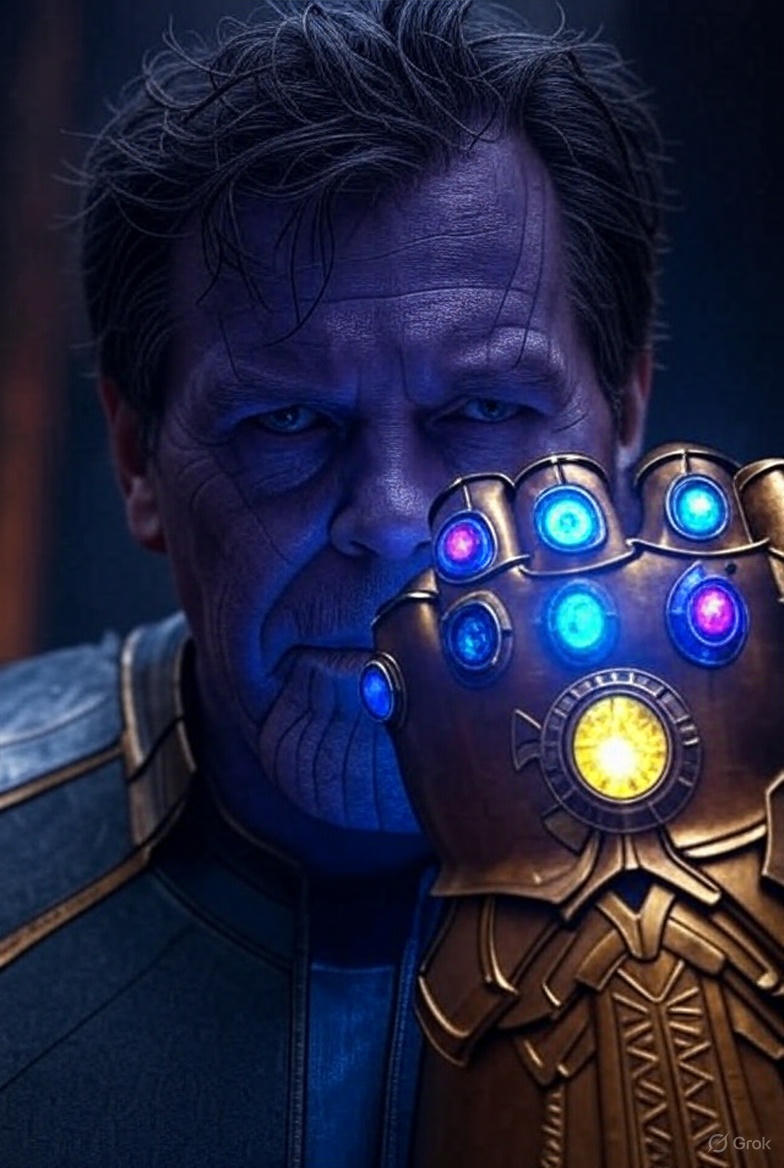
Thanos

Marvel Cinematic Universe

Flaw Type: Pragmatism

The Single Flaw

"His flaw is his self-appointed role as 'savior'. His paternalistic view that he alone knows what's best makes him inflexible and reliant on a single, reversible solution (the Infinity Gauntlet)."

Thanos was not a madman. He was a mathematician of doom — a being who looked at overpopulation, resource depletion, and suffering across the cosmos, and arrived at a solution so brutal it seemed, to him, tragically logical: eliminate half of all life to save the other half.

His plan was perfectly balanced, as all things should be. And for a brief, horrifying moment, he succeeded. But perfection in theory is not perfection in practice. Thanos’s greatest strength—his unyielding pragmatism—was also his fatal flaw, leading to two major, irreversible missteps that ultimately caused his defeat.

The Savior Complex and Dogmatic Pragmatism

Thanos didn't see himself as a villain. He saw himself as the **universe's only hope**, a necessary evil. This paternalistic, messianic view blinded him to alternative, creative solutions. He dismissed diplomacy, technological innovation, or equitable resource redistribution because they were too slow, too messy, or required trusting others.

He was convinced his logic was flawless because it was derived from his experience watching his home world, Titan, collapse. This experience transformed his pragmatism into rigid dogma. He believed the universe was a closed system where zero-sum solutions were the only possible ones, leading him to overlook the possibility of **infinite resources** or growth. This inflexibility was a philosophical weakness that the heroes, driven by hope and creativity, were able to exploit.

The Single Point of Failure

The Infinity Gauntlet was not just a weapon — it was **the entire plan**. Every step, every sacrifice, every alliance was built around acquiring six stones. The moment he began collecting them, he created a catastrophic single point of failure. By concentrating all of the universe's power into a single, physical artifact, he gave his enemies a clear, tangible objective.

Furthermore, the acquisition of the Soul Stone revealed another layer of his flaw. To gain the stone, he sacrificed the one thing he truly loved: his daughter, Gamora. The stone's price confirmed he had a capacity for love, which he coldly traded for his "greater good." This moment showed that while he could perform the ultimate sacrifice, he was utterly incapable of factoring love, hope, or selfless sacrifice into his equations—the very things that ultimately fueled the Avengers.

The Refusal to Adapt (The *Endgame* Trap)

When the Avengers found him years later, Thanos had already won. He could have lived in peaceful retirement on his garden planet, secure in his success. Instead, when he learned his plan was being undone, his dogmatic pragmatism turned into psychotic rage.

The Thanos of *Endgame* made an even grander, more destructive decision: to destroy and remake the universe entirely, believing the existing one was "ungrateful" for his salvation. This shift showed that his belief in the balance was superficial; his real motivation was his ego and his need to be universally recognized as correct. His inability to simply let his win stand and adapt to the passage of time cemented his flaw: a true pragmatist would have moved on; a flawed dogmatist fights the same war until annihilation.

The Final Miscalculation: Inevitability

In his last battle, Thanos declared: "I am inevitable." He believed his victory was mathematically predetermined. But he forgot one thing: **heroes don't give up**. Tony Stark's final, life-ending snap was not a calculated move from a spreadsheet. It was an emotional, desperate, and sacrificial act fueled by love and conviction—the very kind of irrationality Thanos dismissed as weakness.

Thanos's cold, linear logic couldn't account for the non-linear power of attachment and devotion. This blind spot was the specific tool that allowed the Avengers to beat him, not through superior strength, but through a superior *philosophy*.

The Final Irony:

"The Titan who sought to save the universe through cold logic was undone by the one variable he never accounted for: **human will**."

Join the Skelejar Archive

Receive analysis of villain flaws and subscribe for community updates.